It’s Monday morning. You step on the scale after being “so good” all week, take a deep breath, and… you’re right back where you started.

Sound familiar?

If you’ve ever felt like your weight loss journey is an endless game of two steps forward, two steps back, you aren’t alone. Most people who struggle to lose weight are actually crushing their goals 71% of the time.

That’s Monday through Friday – – 5 out of 7 days of solid effort, mindful eating, & sticking to the plan. But those remaining 2 weekend days? They might be silently undoing everything you worked so hard to achieve. (argh)

Before you start questioning your willpower or blaming your metabolism, let’s break down what’s actually happening—and how to fix it.


The Weekend Math: How 48 Hours Erase 5 Days of Progress

To understand why the scale won’t budget, we have to look at the numbers. Calorie balance doesn’t reset at midnight on Friday; your body operates on a weekly average.

Let’s look at a typical scenario:

  • Your Daily Maintenance: 2,000 calories

  • Your Weekday Goal: 1,600 calories (a 400-calorie daily deficit)

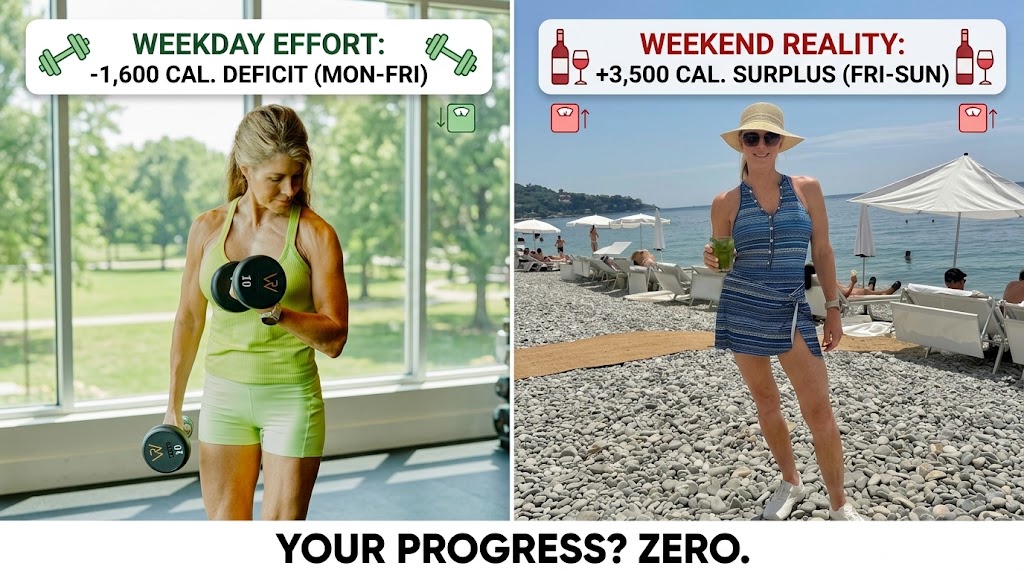
  • Your Weekday Deficit: 4 days X 400 calories = 1600 calorie deficit

You head into Friday feeling victorious. But then the weekend unfolds:

  • Friday: Happy hour drinks, appetizers, & late-night snacking (3,000 calories)

  • Saturday: Bottomless brunch, coffee treats, and dinner out (3,500 calories)

  • Sunday: Family BBQ, side dishes, and dessert (3,000 calories)

Now let’s do the weekend math:

  • Weekend Maintenance: 3X 2,000 = 6,000 calories

  • Weekend Actual Consumed: 3,000 + 3,500 + 3,000 = 9,500 calories

  • Weekend Surplus: 3,500 calories (9,500 – 6,000 for 3X daily maintenance) 

The Result: Your 3,500-calorie weekend surplus completely wipes out your 1,600 calorie weekday deficit—leaving you in a net surplus for the week.

Progress made? Zero. No wonder the scale won’t budge on Monday.

(If seeing that Monday morning number constantly ruins your week, it might be time to change your relationship with tracking altogether. Check out my post on Is it time to break up with your scale? to rethink how you measure success.)


Why Weekends Are So Hard (It’s Not Just Willpower)

After coaching over 10,000 women, I can tell you that weekend overeating isn’t a character flaw. It happens because of four predictable triggers:

  1. Your Structure Vanishes: No work schedule means no set meal times. Grazing, mindlessly snacking, and eating on impulse take over.

  2. Social Pressures Multiply: Birthdays, date nights, family dinners—suddenly food becomes the central focus of every social interaction.

  3. Decision Fatigue Sets In: After white-knuckling your way through a strict diet all week, your self-control is exhausted. Naturally, you want to relax.

  4. The “I Deserve This” Trap: Telling yourself you were “good” all week creates a reward mentality that justifies letting loose.


3 Weekend Strategies That Actually Work

Successful long-term weight loss isn’t about being perfect Monday through Friday and going wild on Saturday and Sunday. It’s about building a sustainable routine across all 7 days.

Instead of falling into the restrict-and-binge cycle, try these three strategies this weekend:

1. The Pre-Event Buffer

Never head to a party, restaurant, or event completely famished. Eat a protein-rich snack (like Greek yogurt, a protein shake, or a handful of almonds) 30-60 minutes before you leave. Drink 8 oz of water (sparkling helps even more!). Arriving satisfied allows you to make conscious choices rather than eating on impulse.

2. Be Selective With Your Indulgences

You don’t have to indulge in every food opportunity that presents itself. Be selective. Is your best friend’s homemade birthday cake worth it? Absolutely. Are the generic potato chips sitting in a bowl at the party worth it? Probably not. Choose the items you genuinely love and skip the filler.

3.  Build a Calorie Cushion

If you know Saturday night involves a big dinner out, plan for it ahead of time. Trim 100–150 calories from your daily targets on Thursday and Friday by adjusting portion sizes or skipping liquid calories. This creates a safety margin you can draw from guilt-free.


The Mindset Shift: Drop the “Cheat Day” Mentality

The single biggest shift you can make is removing the labels. Stop viewing weekdays as “diet days” and weekends as “cheat days.”

When you treat every day as an opportunity to nourish your body, include foods you love, and support your long-term goals, the weekend stops being a trap. Weekends simply become days where you might enjoy a little extra food—without wiping out all your hard work.

You got this.
Have you ever walked into a room only to forget why you went there? Or found yourself grasping for a familiar name mid-conversation? While occasional slip-ups are a normal part of life, taking active care of your mind doesn’t have to be a guessing game.

Renowned double board-certified psychiatrist, 12-time New York Times best-selling author, and founder of Amen University, Dr. Daniel Amen, has dedicated his career to studying brain imaging and cognitive health. Dr. Amen and his team at Amen University advocate for a “memory-friendly lifestyle” built on five actionable pillars.

By turning these five daily habits into long-term routines, you can support your brain’s natural adaptability and build cognitive resilience for years to come.

The 5 Pillars of Brain Health

  1. Restorative Sleep

Sleep isn’t passive downtime; it’s when your brain performs vital routine maintenance. During deep sleep, the brain clears out metabolic waste, consolidates memories, and recharges energy for the day ahead. Skimping on quality sleep can lead to brain fog, lower focus, and reduced emotional balance. Aim for 7 to 8 hours of uninterrupted, quality sleep each night to give your mind the rest it needs.  (see this post!)

  1. Regular Movement

Physical activity isn’t just for your muscles and heart—it is essential for your brain. Exercise increases blood flow, delivering vital oxygen and nutrients to neural pathways. Whether it’s a 20-minute brisk walk, light cardio, strength training, or yoga, staying active keeps your physical body fit while keeping your cognitive functions sharp.  (see this post!)

  1. Brain-Healthy Nutrition

Your brain uses about 20% of the energy your body consumes, making proper fuel non-negotiable. A memory-friendly diet focuses on nutrient-dense whole foods:

  • Leafy greens and colorful vegetables to combat inflammation.
  • Healthy fats (like avocados, nuts, and omega-3s) to support brain cell structure.
  • Quality proteins to maintain stable energy and mood. Avoiding excessive sugar and processed foods helps prevent energy crashes that dull your mental acuity.
  1. Continuous Learning

Thanks to neuroplasticity, your brain can form new connections at any stage of life. To keep it sharp, you must challenge it regularly. Pick up a new hobby, learn a language, practice a musical instrument, or read challenging books. Constantly feeding your brain novel experiences helps build a robust “cognitive reserve”.

  1. Meaningful Connection

Human beings are wired for connection, and social interaction is a cornerstone of brain vitality. Spending quality time with family, engaging with friends, or participating in community groups helps reduce stress and prevents the cognitive decline associated with isolation. Prioritizing relationships with people who uplift you nourishes both your mind and emotional well-being.

Quick Takeaways

  • Brain health is a daily practice: Small, consistent actions compound over time to create lasting cognitive benefits.
  • Protect the basics: Quality sleep and physical movement are foundational to mental clarity and energy.
  • Fuel and challenge: What you put into your body directly affects how you think, while continuous learning keeps neural networks active.
  • Social ties matter: Staying connected to friends, family, and community provides critical emotional and mental stimulation.

Ready to Upgrade Your Brain Health? (Calls to Action)

  1. Pick One Small Pillar Today: Don’t overhaul your life overnight. Choose one habit to start with today—such as going to bed 30 minutes earlier, taking a 15-minute walk, or adding extra leafy greens to your dinner.
  2. Challenge Your Mind: Commit to learning something brand new this week. Pick up a new book, download a language app, or try a new recipe.
  3. Reach Out to Someone You Care About: Schedule a coffee date, call an old friend, or join a local group to strengthen your social connections.
  4. Explore Brain Health Resources: To learn more about brain-imaging research and actionable cognitive health courses, check out the resources available through Amen University.

You got this!

Every woman who walks into a gym, steps on a scale, or reviews her lab work is carrying something completely different.

Different hormones.
Different stress.
Different genetics.
Different sleep.
Different nutrition.
Different life experiences.

That’s why I often tell my clients: “We’re all snowflakes.”  No two snowflakes are identical, and no two women are either.

You didn’t wake up today with the exact same body, energy, or recovery capacity as the woman next to you. Maybe she slept eight uninterrupted hours while you were awake worrying about aging parents or a sick child. Maybe you’ve entered menopause, have Hashimoto’s, lipedema, or you’re recovering from an injury. Maybe you’re thriving. Maybe you’re just surviving.

All of those things matter.

Yet we continue to compare ourselves.

We compare our weight.
Our strength.
Our pace.
Our wrinkles.
Our metabolism.
Our progress.

But comparison ignores the most important variable:

Your starting point is yours alone.

Stop Chasing Someone Else’s Finish Line

Social media makes it easy to believe everyone else has figured it out.

The truth?

You rarely see the full picture.

You don’t see their genetics.
You don’t see their medications.
You don’t see their stress levels.
You don’t see their lab work.
You don’t see their struggles.

Trying to compare your Chapter 3 to someone else’s Chapter 20 is exhausting—and unfair.

The Best Health Plan Is Personalized

One-size-fits-all fitness doesn’t exist.

The “perfect” workout for your friend may leave you exhausted.

The diet that helped someone lose weight may not support your hormones.

The supplement everyone raves about may not be what your body needs.

Even your blood work should be interpreted in the context of you—your symptoms, your lifestyle, your age, your goals, and your medical history.

The healthiest women aren’t necessarily doing the same things.

They’re doing the things that are right for their bodies.

Celebrate Progress, Not Perfection

Instead of asking,

“Why don’t I look like her?”

Ask,

“Am I stronger than I was three months ago?”

“Am I sleeping better?”

“Do I have more energy?”

“Am I nourishing my body?”

“Am I building muscle that will serve me for decades?”

Those are the questions that truly move the needle on longevity.

Be Your Own Greatest Comparison

The only person worth comparing yourself to is the woman you were yesterday.

Celebrate every victory.

Every workout.

Every healthy meal.

Every pound lifted.

Every walk taken.

Every good night’s sleep.

Every choice that moves you toward a stronger, healthier future.

Because your journey doesn’t have to look like anyone else’s to be successful.

It only has to be authentically yours.


Your Challenge This Week

The next time you find yourself comparing your body, progress, or health journey to someone else’s, pause and remember:

You are a snowflake. Wonderfully unique. Beautifully designed. Entirely incomparable.

Honor your journey, trust your process, and keep becoming the healthiest version of you.

YOU got this, snowflake!

Why This Matters So Much for Women

Women, especially, have been conditioned for years to fear muscle.

Many still believe lifting weights will make them “too bulky.”

In reality, most women struggle to build substantial muscle due to hormonal differences and often undereating protein and calories.

What resistance training actually does for most women is:

  • improve body composition
  • increase strength
  • support bone density
  • improve confidence
  • improve metabolism
  • create a more resilient body

And perhaps most importantly …it helps preserve independence later in life.

The ability to:

  • stand up easily
  • carry groceries
  • catch yourself from a fall
  • climb stairs
  • travel confidently
  • stay active with grandchildren

These are strength qualities.

And they matter. Deeply.

Muscle Is About More Than Aesthetics…

Yes, building muscle can improve physique goals. But the bigger picture is healthspan. Not just living longer — but living better longer.

Too many people wait until they feel weak, unstable, injured, or exhausted before prioritizing strength training. The better strategy is to build reserves now.

Every workout is a deposit into your future.

Every rep is preparation for the decades ahead.

Start Where You Are. My friends, you do not need:

  • a perfect body
  • a gym membership
  • fancy equipment
  • extreme workouts

You simply need to begin. TODAY.

Start with:

  • bodyweight squats
  • resistance bands
  • dumbbells
  • modified push-ups
  • step-ups
  • controlled movements

Progress gradually. Stay consistent. Train with intention.

And remember, small efforts compound over time.

Final Thoughts

If you want stronger bones, better energy, improved metabolism, more confidence, better mobility, and greater resilience as you age…

Build muscle.  Lift weights. Prioritize protein. Slow down the lowering phase.

Stay consistent enough for the science to work in your favor.

Because muscle loss is not just cosmetic.

It affects nearly every aspect of long-term health and function.

And the beautiful thing is:
your body is incredibly adaptable at almost any age.

It’s never too late to get stronger. 💪

You got this.


In Part 1, we learned that aging is essentially “accumulated damage.” If that sounds heavy, here is the good news: you are the architect of your own environment. A massive portion of chronic disease risk is driven by factors we can actually control.

By mastering these three pillars, you aren’t just “living healthy”—you are systematically reducing the friction that causes your biological clock to tick faster.

I. Sleep: The Body’s Nightly “Cleanup Crew”

Sleep isn’t just rest; it’s a metabolic car wash. This is when your brain flushes out toxins and your immune system scans for damage. To optimize this repair window:

  • The Consistency Rule: Go to bed and wake up at the same time every single day. Your biological clock (circadian rhythm) thrives on predictability.

  • The 8-Hour Window: Aim to be in bed for 7–9 hours. Even if you don’t sleep every minute of it, giving your body that dedicated “dark time” is essential.

  • The Golden Hour: Initiate a 60-minute digital sunset before sleep. No blue light, no stressful emails—just reading, stretching, or meditation.

  • The Digestive Gap: Finish your last bite of food at least 4 hours before bed. Digestion is an energetic process; if your body is busy breaking down a late snack, it can’t focus on cellular repair.

II. Exercise: Strengthening the Vessel

Movement is the signal that tells your body it is still “needed.” Without it, your systems begin to atrophy. Aim for at least 6 hours of total activity per week, focusing on three specific disciplines:

  • Resistance Training: “Lift heavy things.” Building and maintaining muscle mass is one of the greatest predictors of longevity and metabolic health. (There’s a reason you hear me repeat this over and over and over again, LADIES!!!)

  • Cardiovascular Health: Get your heart rate up through walking, swimming, or cycling to keep your “pipes” (arteries) clear and flexible.

  • The “Supple” Practice: Dedicate time to stretch, balance, and breathe. Mobility ensures you stay injury-free, while deep breathing regulates the stress hormones that drive aging.

III. Nutrition: Fueling for Repair, Not Just Energy

What you eat provides the raw materials for your body’s self-repair kit. The goal is to maximize nutrients while minimizing “biological noise.”

  • Crowd Out the Chaos: Try your best to eliminate processed junk, chronic overeating, and added sugars. These are the primary drivers of the inflammation we discussed in Part 1.

  • The Power List: Build your plate around vibrant vegetables, extra virgin olive oil (liquid gold for your heart), antioxidant-rich berries, high-quality protein, nuts, and seeds.

  • Timing is Everything: Remember the 4-hour rule. Ending your eating window early in the evening mimics a mini-fast, allowing your insulin levels to drop and your “anti-aging” genes to turn on while you sleep.

The Bottom Line

You don’t need a laboratory to slow down aging; you just need a routine. When you master the basics of how you move, eat, and rest, you stop being a victim of “wear and tear” and start becoming a master of your own vitality.

Every little bit helps!

You got this.

Using the famous NASA twin study as a backdrop, this message highlights that aging is not just a passage of time, but the accumulation of biological damage.

The summary can be broken down into three core pillars:

  • The Environment-Biology Link: Space travel showed how quickly harsh conditions (radiation, stress, and microgravity) can damage DNA and accelerate aging. On Earth, our daily environment and habits do the same thing at a different scale.

  • The Power of Prevention: Using the North Karelia Project in Finland as an example, the text demonstrates that large-scale lifestyle changes (improving diet, reducing smoking) can slash heart disease deaths by over 80%. It’s much easier to prevent damage—like arterial plaque—than it is to reverse it once it’s set in.

  • Prioritizing the Body’s Repair Shop: Your body is naturally designed for “anti-aging” through self-repair, but it needs the right conditions to work. Poor habits, like late-night heavy meals or lack of sleep, hijack the body’s resources, preventing it from performing critical tasks like fighting inflammation or destroying precancerous cells.

The Bottom Line: You can dramatically slow your biological clock by systematically reducing damaging exposures and giving your body the space and sleep it needs to repair itself.

You got this.

In previous posts, I’ve talked about how & why muscle loss can happen as we get older (sarcopenia). This ‘50% Protein Bump’ strategy is a practical blueprint for fighting back. It’s not about perfection; it’s about leveling up your intake to give your body the raw materials it needs to stay strong.

The latest research is clear: to maintain muscle as we age, we need to stop treating protein like an optional supplement and start treating it like a priority. Instead of making tiny adjustments, aim to increase your protein intake by 50% to 100% to see real changes in metabolism, appetite control, and muscle retention.

Key Takeaways for Your Muscle-Building Journey:

  • The “Secret” Benefit: Beyond building muscle, high protein intake makes healthy eating easier. By naturally suppressing hunger and cravings, it removes the “willpower” struggle from your diet.

  • Know Your Baseline: The average woman eats about 69g of protein, and the average man about 96g. To hit the “50% increase” goal, women should aim for an additional 35g daily, and men an additional 48g.

  • The “Palm” Rule: Forget the food scale. One palm-sized portion of meat or fish is roughly 20–30g of protein. Adding just two extra “palms” to your day can get you to that 50% increase.

  • Win the Morning: Most people back-load their protein at dinner. The biggest opportunity for muscle support is before noon.

    • Pro Tip: Mix egg whites into whole eggs to double the protein without changing the taste, or my method of “dinner for breakfast” by eating leftover lean meats in the AM!

  • Progressive Loading: Just like lifting weights, you don’t have to hit your max on day one. Add 5–10g of protein to one meal until it feels normal, then stack your wins until you reach your target.

Habit stacking for the protein win!

You got this!


When we think about getting older, most of us don’t picture limitations—we picture possibilities. Maybe you imagine hiking a trail you’ve always loved without needing to stop and catch your breath. Maybe you see yourself dancing at a family wedding, laughing and moving with ease. Or perhaps it’s something quieter, like being able to kneel down to garden, carry groceries without strain, or enjoy long days filled with the energy to actually do what you planned. Whatever your personal vision looks like, one thing holds true: it’s your health that will determine whether those moments feel joyful and accessible—or out of reach.

No matter what your vision looks like, it rests on one simple truth: Your body is the vessel that will carry you into those moments.

And how you care for that vessel today will shape the quality of your tomorrow.

It’s so easy to tell ourselves, “This won’t hurt,” or “I’ll get back on track next week.” It’s easy to take frequent “vacations” from healthy habits and hope the long-term impact will be small. But every choice we make—every skipped meal, every late night, every extra hour of sitting, every day we say “not today” to movement—adds up. Not necessarily in a dramatic way, but quietly, slowly, in the background.

And those small choices shape whether our last few decades feel vibrant and joyful…
or whether we’re “dying a little every day,” giving up mobility, strength, and energy that we could have protected.

The good news?
You have more control than you think.
And caring for your health doesn’t require extremes, punishment, or perfection. It requires daily actions—gentle, consistent, doable steps that honor the body you want to live in later.

Science shows that muscle health, in particular, plays a powerful role in healthy aging. When we challenge our muscles—even with low-impact sculpting or simple resistance work—the body responds beautifully. Stronger muscles support our joints, protect our bones, stabilize our balance, boost circulation, and help reduce the chronic inflammation that chips away at long-term wellness.

But this isn’t just about exercise. It’s about the foundational habits that create a body that will serve you in the decades ahead:

  • Daily movement—even 10–20 minutes adds up more than you realize.

  • Staying hydrated—fueling your cells, muscles, and brain.

  • Sleeping well—giving your body the time it needs to repair and reset.

  • Resistance and mobility work—preserving strength, balance, and ease.

  • Community—because support, connection, and accountability keep you going.

These choices are not small. They’re how you gift your future self the ability to live fully—not just survive.

Your health is worth the effort.
Your dreams are worth the consistency.
And you are worth caring for—today, tomorrow, and in every chapter still to come.

So let this be your gentle reminder—and your call to action:
Don’t wait. Start today. Choose the habits that will help you feel good, move freely, and live the life you imagine.

Your future self will thank you with every step, every adventure, every moment of joy you earned by saying, “My health matters.”

YOU got this.

Lisa

We all know the struggle: you’re brimming with positivity, determined to think and speak happy thoughts. But then, negativity creeps in from those around you. Maybe they don’t understand the power of positive thinking, or perhaps they’re stuck in a rut of complaining and criticizing.

Here’s the good news: you have a choice! You don’t have to get sucked into the vortex of negativity.

The Secret Weapon: Your Tribe

The key to staying positive is surrounding yourself with like-minded people – your “positivity posse.” These are the friends, family, or colleagues who lift you up, inspire you, and celebrate your journey.

Power in Numbers:

Let’s face it, one positive voice is great, but two (or more!) are unstoppable! Partner up with someone who shares your positive outlook. Together, you can gently nudge conversations back towards the light, subtly reminding others of the power of a good attitude.

Leading by Example:

Even if you can’t directly change someone, you can still influence their world. Be the beacon of positivity! Inject optimistic statements into conversations, or simply steer the topic towards something uplifting. Your genuine enthusiasm will be contagious.

Know Your Limits:

Not everyone thrives on positivity. Sometimes, people cling to negativity as a comfort zone. Let them know you care, but also give them the space to find their own path.

The Art of the Exit:

If negativity becomes overwhelming, it’s okay to excuse yourself. Removing your energy from the situation sends a subtle yet powerful message.

Honest Talk:

For those close to you, an honest conversation about negativity might be the key. Remember, awareness is the first step to change.

Positivity is a Magnet:

By surrounding yourself with those who share your positive outlook, you create a powerful force field that attracts others. Soon, you’ll find your positivity posse growing, lighting up the world one positive thought at a time!

You got this!

Ever wonder how much energy you burn outside of the gym? It all comes down to “NEAT” or Non-Exercise Activity Thermogenesis — the fancy way of saying calories burned through everyday activities. From walking the dog to cleaning the house, even minor movements add up throughout the day and contribute to your overall calorie expenditure.

Why is NEAT important?

Desk jockeys, listen up …you might think that gym time is enough, but neglecting movement throughout the day can hinder your progress. Here’s where NEAT comes in. By staying active during your daily routine, you can unlock a treasure trove of health benefits:

  • Burn more calories, all day long: Forget the all-or-nothing mindset. Every step, fidget, and chore adds up to a significant calorie burn, even outside of the gym.
  • Boost your overall health: NEAT isn’t just about aesthetics. It can contribute to better blood sugar control, a healthier heart, and easier weight management.

How to boost your NEAT:

The good news is, NEAT is everywhere! Here are some ideas to get you moving more:

  • Take the stairs: Ditch the elevator for a quick leg workout.
  • Park further away: Add a few extra steps to your errands.
  • Pace while on the phone: Turn those phone calls into mini walking breaks.
  • Fidget freely: Don’t be afraid to tap your foot or drum your fingers – it all adds up!
  • Stand up and move: Consider a standing desk or take short walking breaks throughout the workday.
  • Embrace daily activities: Cleaning, gardening, and playing with your kids are all NEAT opportunities.

Measuring NEAT:

While a “dressed up step count” isn’t the most precise method, aiming for 8,000-10,000 steps daily is a good starting point to track your NEAT activity.

Remember: Small steps = big results! Even simple movement boosts your body’s daily calorie burn, making you healthier.

Want more? Check out this NCBI research of this ISSA article on the subject!

You got this.


(Walk me!)