
It’s Monday morning. You step on the scale after being “so good” all week, take a deep breath, and… you’re right back where you started.

Sound familiar?

If you’ve ever felt like your weight loss journey is an endless game of two steps forward, two steps back, you aren’t alone. Most people who struggle to lose weight are actually crushing their goals 71% of the time.

That’s Monday through Friday – – 5 out of 7 days of solid effort, mindful eating, & sticking to the plan. But those remaining 2 weekend days? They might be silently undoing everything you worked so hard to achieve. (argh)

Before you start questioning your willpower or blaming your metabolism, let’s break down what’s actually happening—and how to fix it.


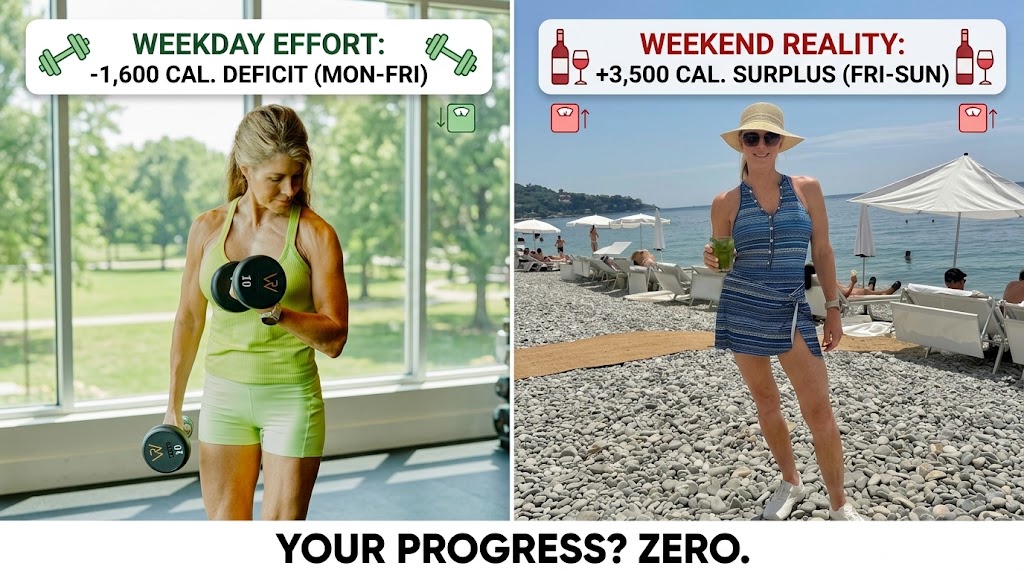
The Weekend Math: How 48 Hours Erase 5 Days of Progress

To understand why the scale won’t budget, we have to look at the numbers. Calorie balance doesn’t reset at midnight on Friday; your body operates on a weekly average.

Let’s look at a typical scenario:

  • Your Daily Maintenance: 2,000 calories

  • Your Weekday Goal: 1,600 calories (a 400-calorie daily deficit)

  • Your Weekday Deficit: 4 days X 400 calories = 1600 calorie deficit

You head into Friday feeling victorious. But then the weekend unfolds:

  • Friday: Happy hour drinks, appetizers, & late-night snacking (3,000 calories)

  • Saturday: Bottomless brunch, coffee treats, and dinner out (3,500 calories)

  • Sunday: Family BBQ, side dishes, and dessert (3,000 calories)

Now let’s do the weekend math:

  • Weekend Maintenance: 3X 2,000 = 6,000 calories

  • Weekend Actual Consumed: 3,000 + 3,500 + 3,000 = 9,500 calories

  • Weekend Surplus: 3,500 calories (9,500 – 6,000 for 3X daily maintenance) 

The Result: Your 3,500-calorie weekend surplus completely wipes out your 1,600 calorie weekday deficit—leaving you in a net surplus for the week.

Progress made? Zero. No wonder the scale won’t budge on Monday.

(If seeing that Monday morning number constantly ruins your week, it might be time to change your relationship with tracking altogether. Check out my post on Is it time to break up with your scale? to rethink how you measure success.)


Why Weekends Are So Hard (It’s Not Just Willpower)

After coaching over 10,000 women, I can tell you that weekend overeating isn’t a character flaw. It happens because of four predictable triggers:

  1. Your Structure Vanishes: No work schedule means no set meal times. Grazing, mindlessly snacking, and eating on impulse take over.

  2. Social Pressures Multiply: Birthdays, date nights, family dinners—suddenly food becomes the central focus of every social interaction.

  3. Decision Fatigue Sets In: After white-knuckling your way through a strict diet all week, your self-control is exhausted. Naturally, you want to relax.

  4. The “I Deserve This” Trap: Telling yourself you were “good” all week creates a reward mentality that justifies letting loose.


3 Weekend Strategies That Actually Work

Successful long-term weight loss isn’t about being perfect Monday through Friday and going wild on Saturday and Sunday. It’s about building a sustainable routine across all 7 days.

Instead of falling into the restrict-and-binge cycle, try these three strategies this weekend:

1. The Pre-Event Buffer

Never head to a party, restaurant, or event completely famished. Eat a protein-rich snack (like Greek yogurt, a protein shake, or a handful of almonds) 30-60 minutes before you leave. Drink 8 oz of water (sparkling helps even more!). Arriving satisfied allows you to make conscious choices rather than eating on impulse.

2. Be Selective With Your Indulgences

You don’t have to indulge in every food opportunity that presents itself. Be selective. Is your best friend’s homemade birthday cake worth it? Absolutely. Are the generic potato chips sitting in a bowl at the party worth it? Probably not. Choose the items you genuinely love and skip the filler.

3.  Build a Calorie Cushion

If you know Saturday night involves a big dinner out, plan for it ahead of time. Trim 100–150 calories from your daily targets on Thursday and Friday by adjusting portion sizes or skipping liquid calories. This creates a safety margin you can draw from guilt-free.


The Mindset Shift: Drop the “Cheat Day” Mentality

The single biggest shift you can make is removing the labels. Stop viewing weekdays as “diet days” and weekends as “cheat days.”

When you treat every day as an opportunity to nourish your body, include foods you love, and support your long-term goals, the weekend stops being a trap. Weekends simply become days where you might enjoy a little extra food—without wiping out all your hard work.

You got this.
Every woman who walks into a gym, steps on a scale, or reviews her lab work is carrying something completely different.

Different hormones.
Different stress.
Different genetics.
Different sleep.
Different nutrition.
Different life experiences.

That’s why I often tell my clients: “We’re all snowflakes.”  No two snowflakes are identical, and no two women are either.

You didn’t wake up today with the exact same body, energy, or recovery capacity as the woman next to you. Maybe she slept eight uninterrupted hours while you were awake worrying about aging parents or a sick child. Maybe you’ve entered menopause, have Hashimoto’s, lipedema, or you’re recovering from an injury. Maybe you’re thriving. Maybe you’re just surviving.

All of those things matter.

Yet we continue to compare ourselves.

We compare our weight.
Our strength.
Our pace.
Our wrinkles.
Our metabolism.
Our progress.

But comparison ignores the most important variable:

Your starting point is yours alone.

Stop Chasing Someone Else’s Finish Line

Social media makes it easy to believe everyone else has figured it out.

The truth?

You rarely see the full picture.

You don’t see their genetics.
You don’t see their medications.
You don’t see their stress levels.
You don’t see their lab work.
You don’t see their struggles.

Trying to compare your Chapter 3 to someone else’s Chapter 20 is exhausting—and unfair.

The Best Health Plan Is Personalized

One-size-fits-all fitness doesn’t exist.

The “perfect” workout for your friend may leave you exhausted.

The diet that helped someone lose weight may not support your hormones.

The supplement everyone raves about may not be what your body needs.

Even your blood work should be interpreted in the context of you—your symptoms, your lifestyle, your age, your goals, and your medical history.

The healthiest women aren’t necessarily doing the same things.

They’re doing the things that are right for their bodies.

Celebrate Progress, Not Perfection

Instead of asking,

“Why don’t I look like her?”

Ask,

“Am I stronger than I was three months ago?”

“Am I sleeping better?”

“Do I have more energy?”

“Am I nourishing my body?”

“Am I building muscle that will serve me for decades?”

Those are the questions that truly move the needle on longevity.

Be Your Own Greatest Comparison

The only person worth comparing yourself to is the woman you were yesterday.

Celebrate every victory.

Every workout.

Every healthy meal.

Every pound lifted.

Every walk taken.

Every good night’s sleep.

Every choice that moves you toward a stronger, healthier future.

Because your journey doesn’t have to look like anyone else’s to be successful.

It only has to be authentically yours.


Your Challenge This Week

The next time you find yourself comparing your body, progress, or health journey to someone else’s, pause and remember:

You are a snowflake. Wonderfully unique. Beautifully designed. Entirely incomparable.

Honor your journey, trust your process, and keep becoming the healthiest version of you.

YOU got this, snowflake!

When people think about getting healthier, they often picture intense workouts or hours in the gym. But one of the most effective—and sustainable—forms of exercise is something most of us can do every day: walking.

Walking is a low-impact activity that supports fat burning, heart health, circulation, mental well-being, and longevity without placing excessive stress on your joints. Research has even shown that when the same amount of energy is expended, walking can reduce the risk of high blood pressure, diabetes, and heart disease just as effectively as running.

One reason walking is so powerful is that it often keeps you in Zone 2, a moderate-intensity exercise zone where your body becomes more efficient at burning fat for fuel. Better yet, it’s easy to stay consistent with a walking routine, and consistency is what delivers long-term results.

Walking outdoors offers even greater benefits. Natural sunlight helps regulate your circadian rhythm for better sleep, while time spent in nature has been linked to lower stress, improved mood, and enhanced mental clarity. Whether you’re walking through your neighborhood, a local park, or hiking a trail, you’re doing more than exercising—you’re supporting your overall well-being.

Want to maximize your walks? Try adding hills or a treadmill incline, wear a weighted vest once you’ve built a solid walking habit, or invite a friend (or your dog!) to join you. Social connection and fresh air make walking even more enjoyable and beneficial.

You don’t have to reach 10,000 steps overnight. Start by adding a 10–20 minute walk in the morning, a short walk after meals, or simply look for opportunities to move more throughout your day. Every step adds up.

The Bottom Line

Walking may not be flashy, but it remains one of the most powerful tools for improving your healthspan. It strengthens your body, supports your metabolism, boosts your mood, and helps you stay active for years to come.

Ready to put one foot in front of the other? Lace up your shoes, head outside, and make walking part of your daily routine. Your future self will thank you!